Saturday, March 10, 2012

Experts Concerned About Brazil's Readiness

By supersport.com
Venues in Brazil will be ready for the World Cup in 2014 but airports and public transport improvements may struggle to meet the deadline, experts said, as a Fifa team inspected progress.
"Brazil is now starting to prepare its airports but you need at least 10 years to have an airport network in the right condition," said Jose Roberto Bernasconi, president of the Sinaenco architecture and engineering union in Sao Paulo.
Brazil was awarded the World Cup in October 2007 but Bernasconi told AFP that "it was only in 2011 that we started to take things seriously".
Four million tourists are expected to come to Brazil in two years' time, as the South American giant hosts the tournament for the first time since 1950.
But concerns have been expressed about the country's ability to cope with a massive influx of visitors.
Airports are often dilapidated and overcrowded yet the government only awarded contracts to three private consortia in February to redevelop three airports: Guarulhos in Sao Paulo, Viracopos in Campinas and in the capital Brasilia.
In Rio de Janeiro and Belo Horizonte, renovation work should be finished at the end of 2013.
Last Friday, Fifa secretary-general Jerome Valcke said Brazil needed to give itself "a kick up the backside" to make up for lost time in infrastructure work, sparking a blazing row with the government in Brasilia.
Since then, he and Fifa president Sepp Blatter have written to the Brazilian government to apologise. Valcke claimed that his remarks were given a much stronger meaning in Portuguese.
Some 40 experts from Fifa and the local organising committee on Tuesday began a six-day tour of six of the 12 cities that will host World Cup games in 2014.
Bernasconi, whose union is independently monitoring World Cup projects, said they were confident about the country's ability to host games.
"Certainly, the 12 stadia in Brazil will be ready for the World Cup, some of them just before the competition," he said.
"But other infrastructure work is slipping for the most part."
In particular, the union said that "few cities are actually doing work" to improve their urban transport systems.
The metro project in Salvador de Bahia in northeast Brazil has been gathering dust for the last 12 years while Recife also has yet to complete access to the stadium.
In Brasilia, construction of an overland metro system connecting the airport to the stadium has been on hold since April while in the southern city of Curitiba and northern Manaus, work has not even started.
The government however maintains that 42 of the 51 transport projects will be finished, as scheduled, next year.
In the hotel sector, Sao Paulo is the best prepared but big cities like Rio, Brasilia, Recife, Salvador and Belo Horizonte still have to increase their capacity. In Rio, 17 hotels have to be built between now and 2014.
Fifa has also been pushing lawmakers since 2007 for approval to allow beer to be drunk in venues but the dispensation has been constantly knocked back by parliament.
Sales of alcoholic beverages in sports arenas have been banned in Brazil since 2003 but the bill would create an exception, allowing beer to be sold in plastic cups at World Cup matches.
Fifa has an agreement with its sponsor, the US-based Anheuser-Busch brand Budweiser, and prohibiting beer sales would cut into the football organisation's revenues from the games.
Brazil legend Ronaldo, who is on the local organising committee, has admitted that there is some truth in Valcke's criticisms.
"Brazil said it would pass a law to govern the World Cup as long ago as 2007. There are delays in infrastructure work. There are already a lot of things delayed," he said.

Saturday, August 20, 2011

Brits off to Brazil Due to Double for World Cup 2014


By holidayhypermarket.co.uk

British holidaymakers headed off to the exotic South American destination of Brazil should double in numbers when the country hosts the football World Cup in 2014. 

Brazil holidays promoter Embratur made this claim after their predictions were thoroughly analysed. Embratur president Flavio Dino said that he was confident of Brazil's chances of doubling the influx of British tourists in 2014 as he presented his plans for a number of new initiatives which will be revealed for everyone to see at the forthcoming World Travel Market (WTM). 

Stats revealed that last year nearly 170,000 British holidaymakers jetted off on cheap flights to Brazil. Clearly, this figure will increase dramatically in the lead up to the World Cup as football enthusiasts follow their beloved national team. 

Mr Dino said: "Agents should be aware that we have a very comprehensive and expanding network of airports so it is relatively easy to combine two or three different destinations within a two-week break," he pointed out. 

He added that the number of direct flights to Brazilian destinations have been rapidly increased, making it easier for people to find affordable flights at a time and from a departure location that is convenient to them. 

BA only has already announced its intentions to double cheap flights to Rio de Janeiro from London Heathrow to provide services six times per week. Embratur officials like Mr Dino are convinced that other airlines will follow suit in the run up to the world’s biggest football event. 

Mr Dino added that visitors: "should also be aware there are always hotels being built and new destinations being developed. Earlier this month, Embratur announced a new classification model for all of Brazil's 28,000 hotels in order for tourists to have transparent information on the quality and standards of the country’s accommodation." 

Saturday, June 25, 2011

Jérôme Valcke attacks Brazil's 'slow' preparations for 2014 World Cup


By guardian.co.uk
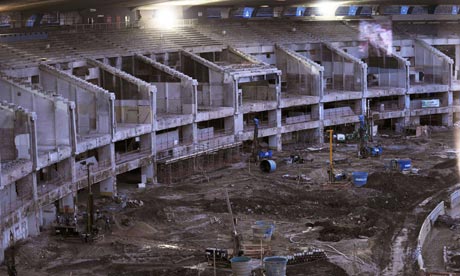
Redevelopment work continuing this month at the Maracanã stadium in Rio de Janeiro. Photograph: Vanderlei Almeida/AFP/Getty Images


Brazil's slow pace of preparation for the 2014 World Cup has been criticised by the controversial Fifa general secretary Jérôme Valcke.
Valcke, making his first public appearance since Fifa exonerated him of wrongdoing for saying Qatar had "bought" the 2022 World Cup hosting rights, said Brazil were well behind schedule on stadium and transport projects.
He told the Inside World Football Forum in Moscow: "There is a lot of work to deliver. We don't have stadiums, we don't have airports, we don't have a national transportation system in place and we are one month away from the preliminary draw.
$16.95 A Day Rental Cars from CarRentals.com

"The Maracanã is definitely not currently a World Cup stadium and that's why it's closed. It will be ready at the last minute, a few months maybe, even a few weeks before the tournament if they don't speed up the process. In São Paulo they will not even be able to play the Confederations Cup in 2013 because the stadium will not be ready."
Valcke suggested the main aim in Brazil was to win the World Cup rather than organise a successful tournament.
"In South Africa the main goal was to show the world that Africa could organise a World Cup. In Brazil, in a way the main issue is to win it. Otherwise they will talk about failure."
He refused, though, to comment on the corruption scandals that have engulfed Fifa. "I'm here to talk about football. Sometimes at Fifa we need this," he said.


Tuesday, June 21, 2011

Rio de Janeiro police clear decks for 2014 World Cup


By australian.com.au


Hundreds of Brazilian police and soldiers backed by helicopters and armoured vehicles swept in to take over a crime-ridden Rio slum yesterday as part of a pacification plan ahead of the football World Cup in 2014.
More than 100 marines, 160 elite police officers and 600 ordinary officers took part in the operation in the hillside Mangueira neighbourhood, which went off without a shot being fired, a police spokesman said.
Mangueira is near Rio's famed Maracana football stadium.
The pre-announced operation began just after dawn with 14 armoured personnel carriers thundering up the slum's steep roads and helicopters clattering overhead, as security forces on foot followed with arms at the ready.
Ninety minutes later, two of the vehicles reached the highest point of the slum and officers hoisted the Brazilian flag atop a water tank. The forces met no resistance. Drug gangs that had been controlling the district had fled well in advance.
"We were woken at six in the morning by the helicopters. Everything was already calm before that. It would have been better if they spent the money on improving the hospitals," said one resident, a kitchen employee and mother of five who gave her first name as Bete.
Her seven-year-old nephew Donatan said he was afraid: "When I heard the noise, my legs started shaking. The house was shaking, too. I thought the police were going to start shooting."
Most residents refused to comment for fear of reprisals in case the drug gangs returned. The few who did refused to give their last name.
"All of that is because of the World Cup. But afterwards, who will make sure it doesn't go back to like before, that the police won't leave?" asked Vera, 54.
Vinicius, 15, feared what the slum would be like under police control. "It's finished, going out at night. We'll have to stay at home."
Some residents said they were worried more about the police than the gang members, who reigned but also provided security. There were also concerns that gunfights might break out between police and drug traffickers.
The operation was the final link in a "security perimeter" authorities have set up around the Maracana stadium, which will play host to the World Cup final, to be watched by more than 700 million television viewers around the world.
It will also be a venue for sports featuring in the 2016 Olympic Games, which Rio will also host.
Unlike in previous years, when the police raided the neighbourhoods only to exit soon after, leaving a vacuum quickly filled by returning gangs, they are setting up local posts in the slums to maintain control.

Wednesday, June 1, 2011

Fifa admits infrastructure problems hampering Brazil 2014 World Cup preparations


By goal.com


Airports, accommodation and transportation are on Fifa's agenda for World Cup 2014 as Valcke admits to issues regarding progress with modernisation.

Fifa secretary general Jerome Valcke admits there are problems with the infrastructure surrounding preparations for World Cup 2014 in Brazil.

Valcke, who was speaking at the Fifa congress in Zurich where Sepp Blatter is running unopposed in the presidential elections, has previously criticised preparations for the slow pace which has hampered progress.

Yet, despite claiming Fifa is working hard to ensure everything is on course, Valcke, who is responsible for overseeing the tournament is delivered on time, admits there are problems.

"We have the full support of the new president of the country [Dilma Rousseff] which gives us confidence in the many problems we have to face which are airports, accommodation and transportation," Valcke said.

"We are working very well with the organising committee and Ricardo Teixeira."

Stadiums have also been hit by delays, but Valcke insists developments are in sight.

"We have been able to finalise with most of the cities about their stadiums," he concluded.

Monday, May 30, 2011

Media centre for 2014 World Cup in Brazil to be located in Rio de Janeiro


By The Associated Press


RIO DE JANEIRO — The International Broadcast Center for the 2014 World Cup will be located in Rio de Janeiro, FIFA said Friday.
Rio won the right over Sao Paulo, South America's largest city, and Brasilia, the nation's capital.
FIFA said Rio was chosen because of its "quality of infrastructure" and "variety of accommodation."
"I can tell you it was a very difficult decision," FIFA secretary general Jerome Valcke said in a statement. "All candidates were of great quality and showed huge commitment. But unfortunately there can only be one selected host and we considered that the best overall for FIFA was Rio de Janeiro."
Rio is set to host the World Cup final at Maracana stadium, while Sao Paulo and Brasilia are two of the cities vying for the opening match three years from now.
The media centre will be located at the Riocentro complex, which accommodated the press centre and some competitions during the 2007 Pan American Games.
"This IBC will be one of the most advanced information centres in the world for the months of June and July 2014," Valcke said. "It is a vital component, linking the FIFA World Cup to the rest of the world and ensuring that people across the globe have the latest and best coverage of our beautiful game."
FIFA said 179 broadcasters from more than 70 countries had onsite productions with 13,000 staff members during the 2010 World Cup in South Africa.
Brazil will be hosting the World Cup for the first time since 1950.

Saturday, May 21, 2011

Pitch guidelines passed on to Host Cities


By FIFA.com


The two-day Seminar for Pitch Preparation for the 2014 FIFA World Cup Brazil™, held in Fortaleza (Ceara state), came to a conclusion yesterday. The event brought together pitch specialists from the 12 Host Cities, with key guidelines being put in place for all the stadiums hosting matches at Brazil 2014.
The event began on Thursday, with the Governor of Ceara state, Cid Gomes, in attendance along with FIFA representatives and members of the 2014 FIFA World Cup Brazil Local Organising Committee (LOC).
FIFA organised the gathering with a view to establishing quality and durability standards applicable to all the pitches to be used at Brazil 2014. In the opinion of world football’s governing body, it is essential that all pitches are managed, maintained and cut according to the same guidelines.
A decision has yet to be made on the types of grass to be used at the tournament. This will be taken once FIFA has carried out studies across the country, which has four different types of climate in the months of June and July, each with different rainfall patterns. Pitch construction is thus a key factor when it comes to standardising guidelines, as drainage and irrigation systems will vary from venue to venue. The grass types selected will need to offer durability as well as the ability to regenerate quickly and adapt to each specific climate.
The Host Cities will receive guidelines on the construction of pitches and the equipment needed to maintain them before and after Brazil 2014. Speakers at the seminar pointed to the need for special pitch care at venues with a cold climate, as tropical grass species have greater difficulty in establishing themselves at low temperatures. Pitch specialists will assess the projects presented by the 12 Host Cities in close detail and will provide their assistance in implementing them.
As the LOC’s Executive Operations Director, Ricardo Trade, explained, the Host Cities have a major responsibility in ensuring they get pitch preparation right.
“As a country famed for its football, the onus and the moral obligation is upon us to stage a superb FIFA World Cup finals, with each venue offering the same level of quality,” he said. “This is our opportunity to show the world just how good we are even when we don’t have the ball at our feet.”